
GRUNDFOS
Role → UX/UI Designer (Part time)
Tenure → Aug 2023–Jan 2025
Skills used → UX research • feature identification • interaction design • UI pattern design • prototyping • cross-functional collaboration
“Bringing feeling of ownership and security for home owners.”
Overview
Grundfos Home gives homeowners control over their water system, but until I joined the team, there were no advanced features or safety settings designed for residential use. My work focused on introducing these features for the first time and designing them in a way that balanced control, clarity, and confidence for everyday users.
Problem
Grundfos Home was in early development when I joined the team, and homeowners had no access to advanced controls or safety features yet. While technicians used such features in professional contexts, homeowners lacked a simple and reassuring way to manage their pumps beyond basic on/off behaviour. This created uncertainty, inconsistent expectations, and limited the value of connected products.
My role was to introduce advanced features for homeowners for the first time and shape how these settings should work, look, and feel in a residential environment — balancing safety, clarity, and ease of use.
Role and Responsibilities
My work was revolving researching user needs and early discovery work for new features that would help home owners feel safe with their domestic water management solutions.
→ Research user pain points with the current setup (booster circulator and use cases)
→ Interview users across different continents
→ Contributed to design systems
→ Design prototypes and use them for usability testing
→ Iterate and refine the designs involving business and development stakeholders
Key Insights
→ Homeowners had different expectations for how their water system should behave, especially in edge cases like interruptions or leaks.
→ Introducing advanced features required clear communication, otherwise users felt uncertain about enabling or trusting them.
→ Users wanted more control, but only when the app explained system behaviour in a simple and reassuring way.
→ Providing adjustable settings (instead of fixed automation) helped users feel confident regardless of their technical experience or home setup.
Selected Work
01
Runtime limit
Overview
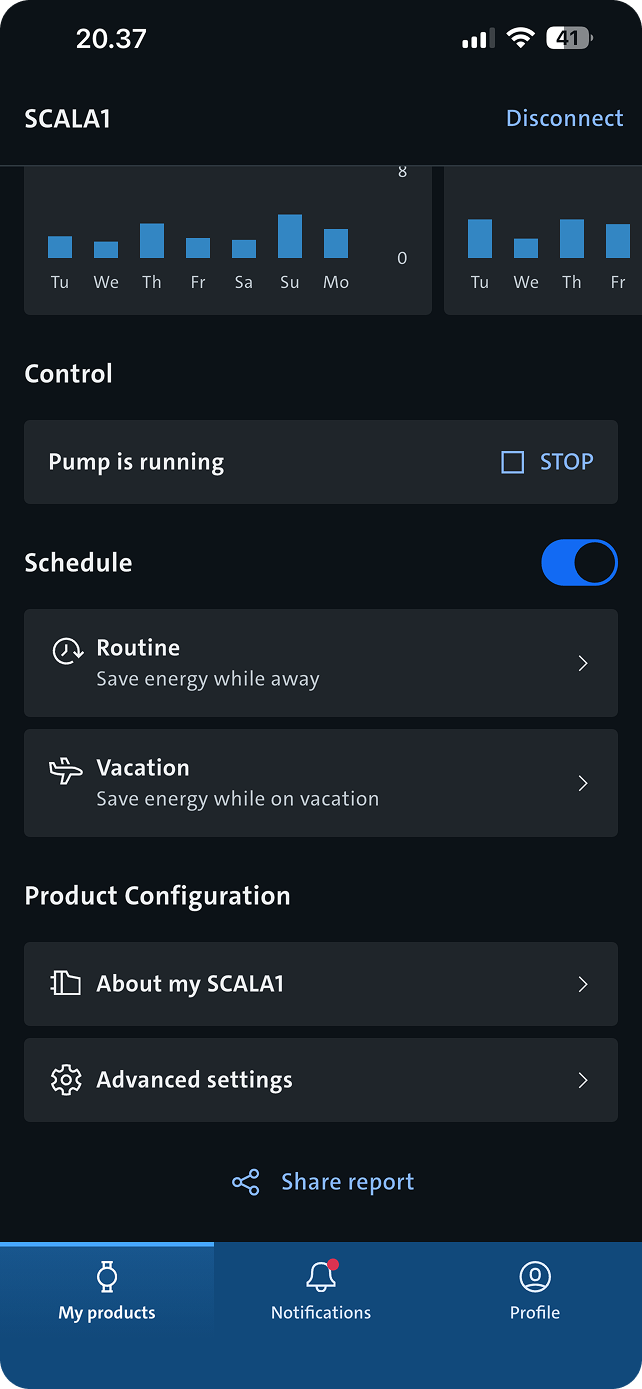
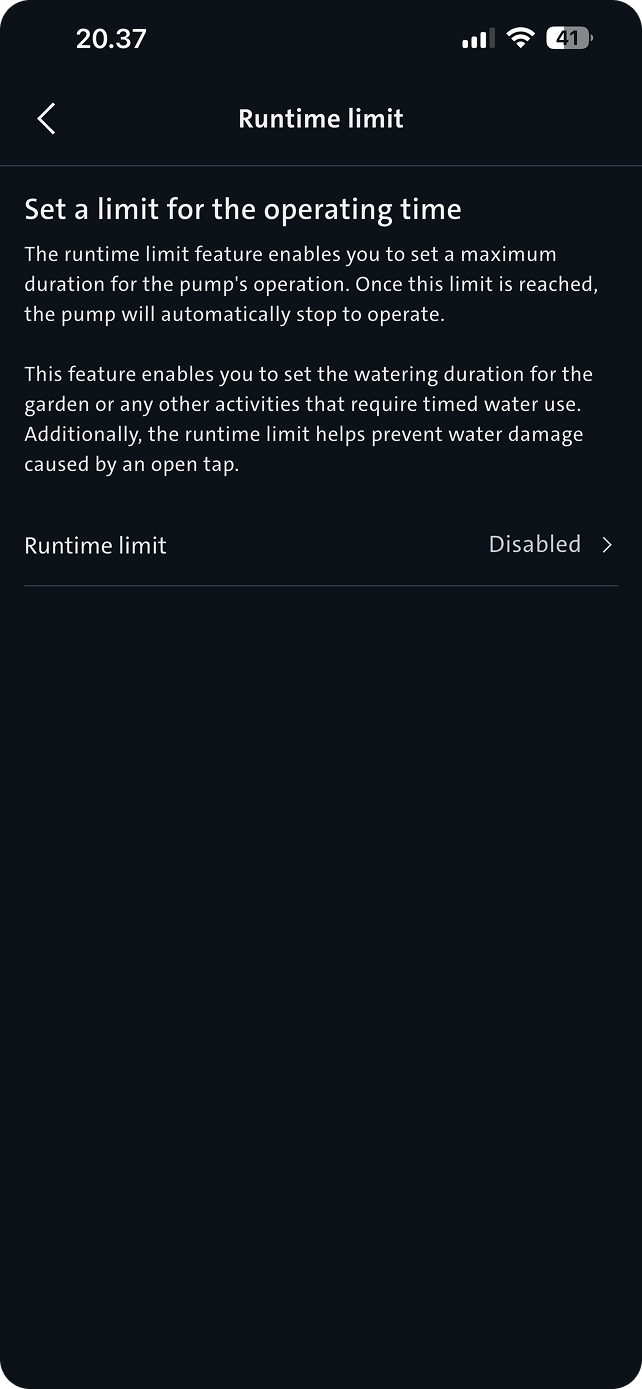
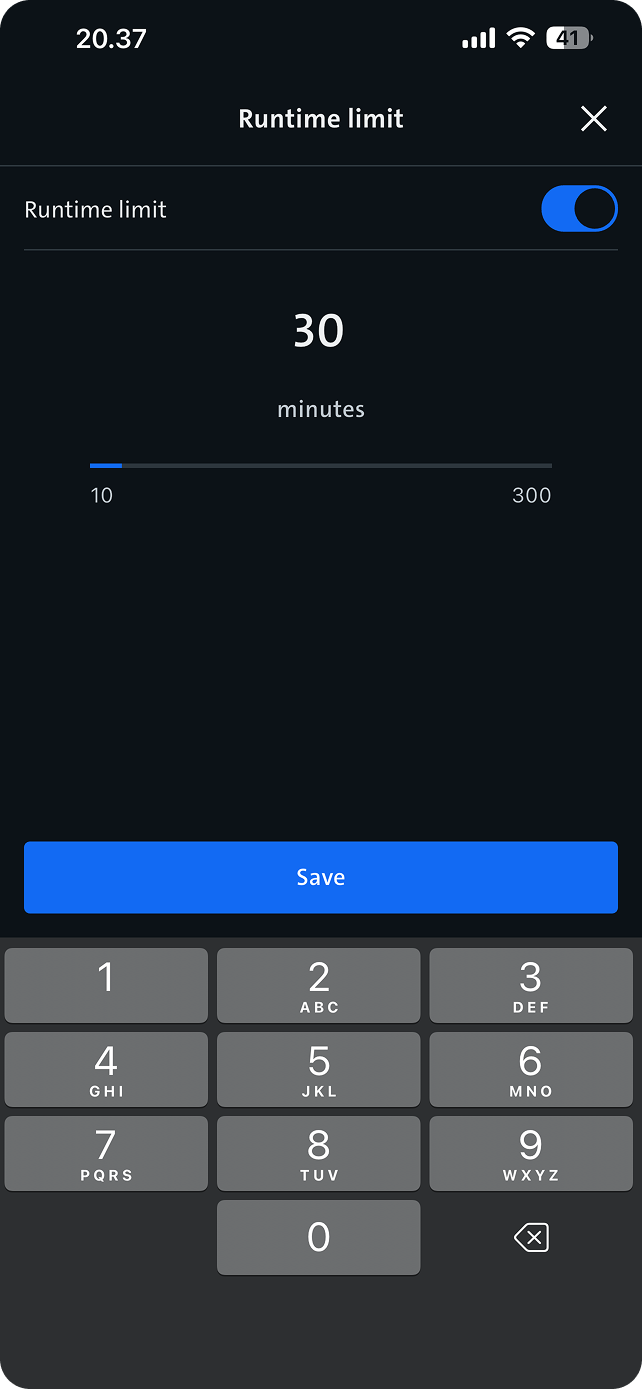
Through user interviews, it became clear that homeowners wanted control over how long the circulator should run, especially when they weren’t sure what the “right” duration was. I introduced runtime limit as an advanced setting that gives users predictable control without requiring technical knowledge. The design focuses on clarity and guidance, helping users feel confident adjusting pump behaviour to their home’s needs.
My Role
My task was to identify new features that could support the value proposition. After completing the homeowner research, the feature identified was the runtime limit.
Skills
Agile • Feature Discovery • UX Research

02
Automatic restart
Overview
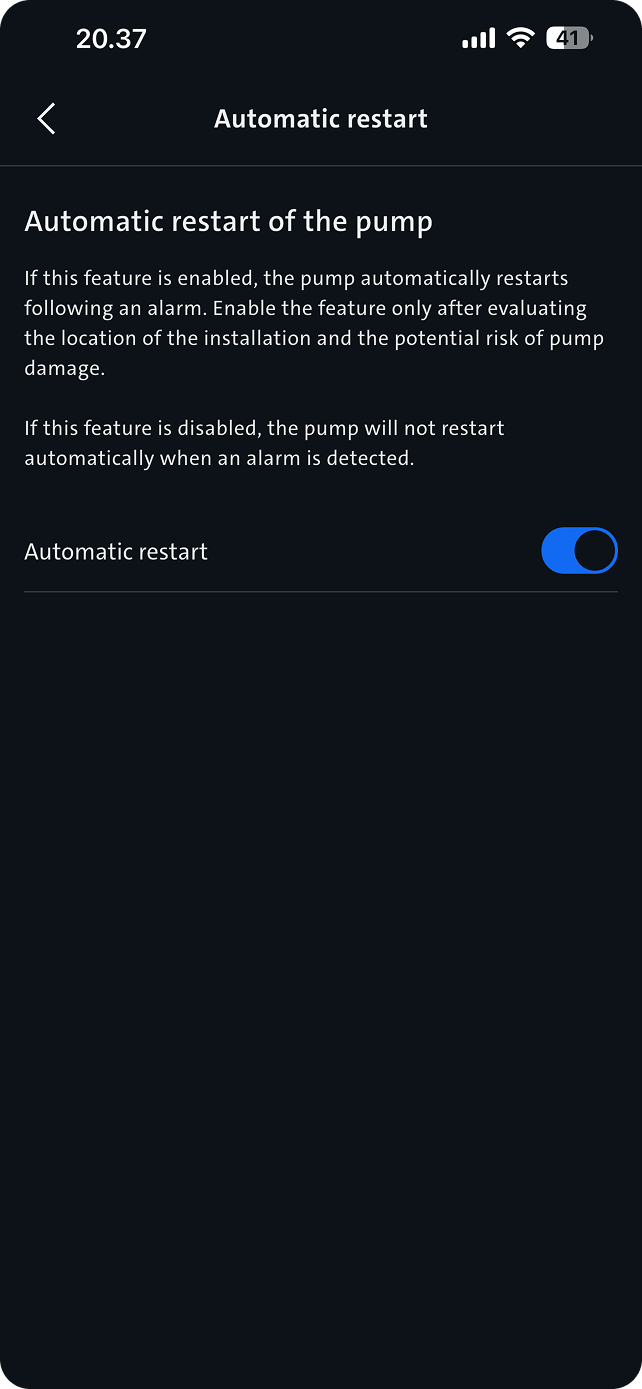
Interruptions in pump operation can happen for many reasons, and homeowners differ in how much automation they’re comfortable with. Some wanted the system to resume automatically; others preferred to decide manually. I designed automatic restart as a flexible setting that supports both preferences, with clear communication about what the system will do in each scenario. This ensured the feature felt safe, transparent, and easy to understand.
My Role
I was responsible for identifying new features that could strengthen the value proposition. Based on insights from homeowner research, the automatic restart feature was identified as a key addition.
Skills
Agile • Feature Discovery • Design Systems • UX Research
03
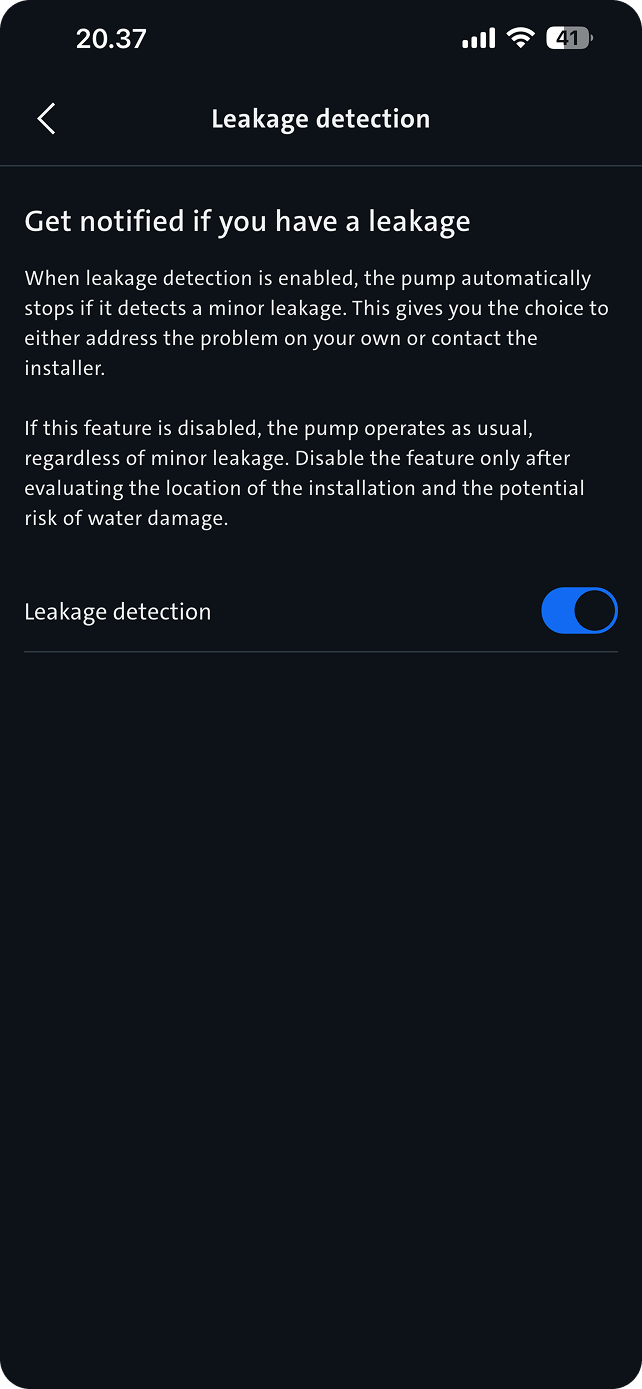
Leakage detection
Overview
Safety expectations vary widely between households and regions. While some users wanted proactive alerts, others worried about false alarms or unnecessary alerts. I introduced leakage detection as a toggle-able safety feature that adapts to different user contexts. The design makes the purpose, behaviour, and consequences of the feature easy to grasp, helping users choose the level of protection that fits their home.
My Role
I translated these insights into actionable design directions, leading to the introduction of a leakage detection setting that users could easily enable or disable. This gave homeowners more confidence and control, allowing the product to accommodate both safety-conscious and performance-oriented use cases.
Skills
Agile • Feature Discovery • Design Systems • UX Research
Impact
→ Introduced advanced pump features to homeowners for the first time, making previously technical functionality accessible and easy to understand.
→ Improved user confidence by offering clear explanations, predictable behaviour, and adjustable settings instead of fixed automation.
→ Enabled the product team to validate new value propositions for connected residential systems through research and prototyping.
→ Created clearer, more intuitive UI patterns that reduced hesitation and helped users make informed decisions about safety and energy use.
→ Provided a scalable foundation for future advanced features by defining how complex system behaviours should be communicated in a residential context.
My time at GRUNDFOS...
Working on Grundfos Home taught me how important it is to introduce complexity gradually and communicate system behavior in a way that feels safe and approachable. Designing advanced features for homeowners required balancing technical accuracy with clear, everyday language and predictable UI patterns.
This project strengthened my ability to turn research into features that support both confidence and control. If I continued this work, I would explore context-aware defaults and progressive onboarding to help users adopt advanced settings more naturally over time.